Chapter 01 of 5
How Hair Gets Its Color From Melanin and Pigment Cells
Hair color comes from melanin made in the hair bulb. Learn the two types of melanin, why color is added only while a hair grows, and what this means for gray.
Updated September 28, 2026
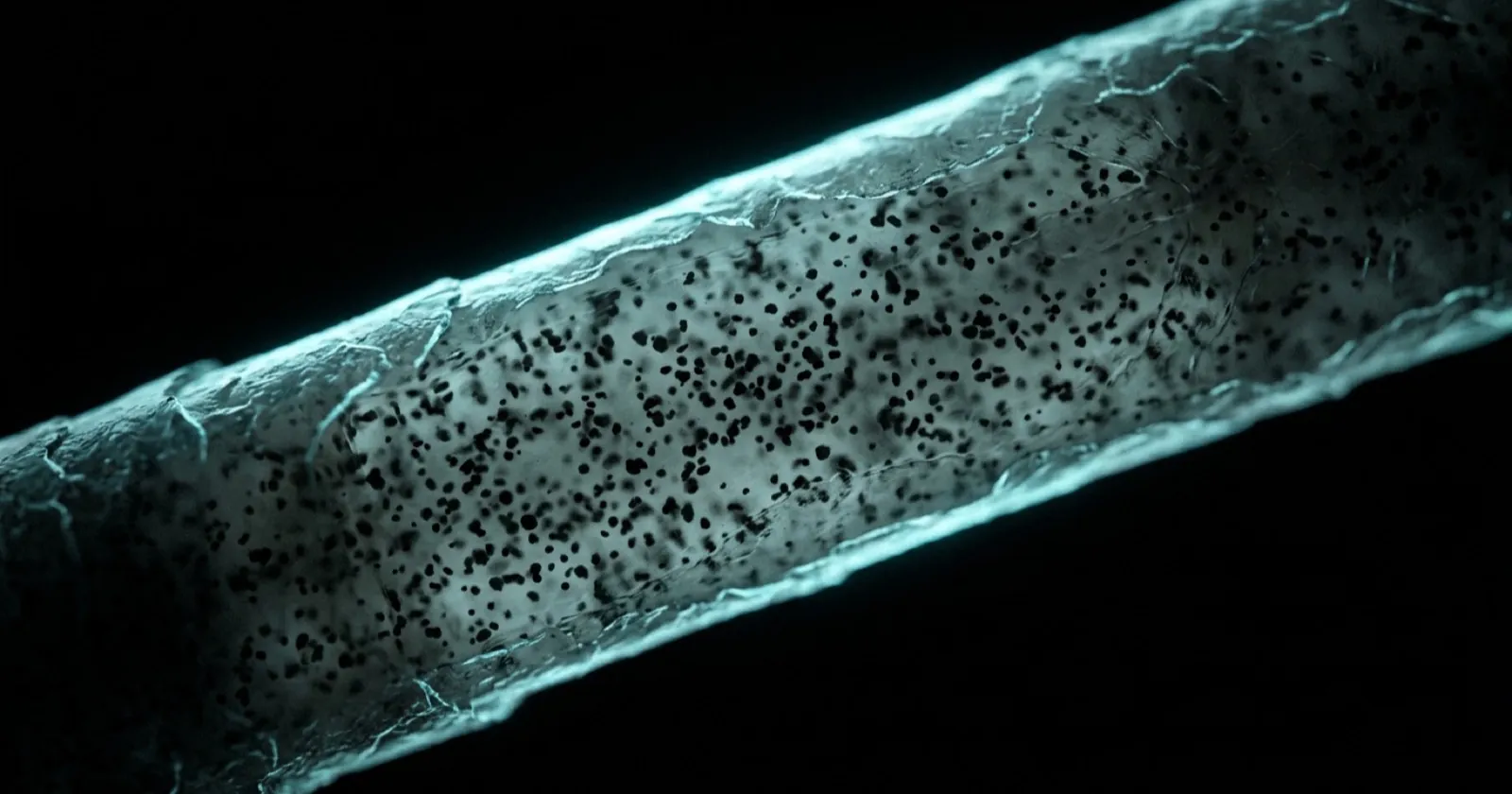
Hair gets its color from melanin, a pigment made by cells called melanocytes. These cells sit in the hair bulb, at the base of each follicle under the skin, and they pass melanin into the cells that become the hair strand. The type of melanin, and how much of it reaches the strand, sets your natural shade.
Two kinds of melanin
Human hair uses two main pigments. Eumelanin gives black and brown shades. Pheomelanin gives red tones. According to MedlinePlus Genetics, a service of the U.S. National Library of Medicine, the natural colors break down like this:
| Hair color | Melanin in the hair |
|---|---|
| Black | A large amount of eumelanin |
| Brown | A moderate amount of eumelanin |
| Blond | Very little eumelanin |
| Red | Mostly pheomelanin, with a little eumelanin |
Melanin is made inside tiny granules called melanosomes. A 2005 review in the Journal of Investigative Dermatology explains that both kinds of melanosome can exist in the same cell. Each granule, though, is committed to making one type of melanin or the other. The final shade depends on the mix.
Where the pigment is made
A follicle is a small pocket in the skin that a hair grows from. At its base is the hair bulb, and near the bottom of the bulb is the dermal papilla, a small group of cells that helps direct hair growth. The same review states that the hair bulb is the only place where pigment for the hair shaft is made.
The pigment cells that are actively working sit in the upper part of the hair matrix, the zone of dividing cells inside the bulb. Just above them are the young hair cells that will form the strand. The melanocytes pass melanin granules to these cells. Most of the pigment goes to the cortex, the thick middle layer of the hair. Less goes to the medulla, the core, and very little reaches the cuticle, the thin outer layer.
This means hair color is teamwork between different cells. The review describes it as a set of close interactions between pigment cells, hair cells and the cells of the dermal papilla.
Color is added only while a hair grows
Every hair goes through a cycle. It grows for a long time, then stops growing during a short transition, then rests before it falls out and a new hair starts. Doctors call these phases anagen, catagen and telogen.
Pigment is tied to the first phase. According to the 2005 review, hair is actively pigmented only during anagen, the growth phase. Melanin production switches off during catagen and stays off through telogen. A 2024 review in the same journal adds that the pigment system comes apart during catagen, the short transition phase after growth. The best time for pigment cells to return and start working again is early in the next growth phase.
So each new hair has to rebuild its pigment supply from the start. If this rebuilding fails, the new hair grows in with less pigment, or none.
The stem cells behind each new hair
The follicle gets fresh pigment cells from a store of melanocyte stem cells. These cells rest in the bulge, an area higher up in the follicle, and a 2020 study in Nature describes them as quiet, or resting, most of the time. The Harvard team behind that study explains their normal job: when hair regenerates, some of the stem cells turn into pigment-producing cells that color the new hair.
A 2023 study in mice, also published in Nature, found that these stem cells move between different parts of the follicle as the hair cycle goes on. They switch back and forth between a resting state and a more active state. In older mice, more of them were stuck in one place and no longer produced new pigment cells.
The 2024 review states that graying becomes permanent only when the stem cells in the bulge are depleted. Until then, a follicle can still supply pigment to new hairs. The 2005 review estimated that a scalp follicle goes through about 7 to 15 rounds of pigment cell renewal over an average of 45 years before gray appears.
Genes set the starting shade
Many genes decide the type and amount of melanin in hair. The best studied is MC1R. It carries instructions for a receptor on melanocytes. MedlinePlus explains that when this receptor is switched on, it pushes melanocytes to make eumelanin. When it is not, they make pheomelanin instead. Some common versions of MC1R weaken the receptor, so the cells make mostly pheomelanin. This is linked to red hair.
MC1R does not explain everything. A large study of hair color in UK Biobank, a British health research database, found that MC1R explains 73 percent of the genetic influence on red hair that the study could measure. The same study linked blond hair to more than 200 genetic variants. Many of the genes involved affect hair growth or texture, which shows how closely hair cells and pigment cells work together.
Another important gene is TYR. It holds the instructions for tyrosinase, which a 2016 study in Nature Communications calls a rate-limiting, essential enzyme in making melanin. In simple terms, the supply of tyrosinase limits how fast melanin can be made. Hair color can also shift with age before graying starts. MedlinePlus notes that blond children often have darker hair by the time they are teenagers. Our page on genetics and gray hair covers the genes linked to graying itself.
The part you see is not alive
A 2013 review in the International Journal of Trichology states that the formed hair shaft contains no living cells, so it is not thought to be able to change on its own. This has two results.
First, a hair's color is fixed once that section has grown. Second, any natural change, such as graying, shows up at the root first. Pulling out a gray hair only removes a strand the follicle has already finished. Our post on whether plucking gray hair makes more grow explains what grows back in its place.
Because color is locked in as a hair grows, a hair holds a record of recent months. Researchers at Columbia University used this in a 2021 study. They measured color along each hair in tiny slices about 1/20 of a millimeter wide, and each slice stood for about an hour of growth. That let them match color changes to stressful weeks. The results are covered in stress and gray hair.
Why hair without pigment looks white
Why does a hair with no melanin look white? A 2013 review in the Indian Journal of Dermatology, Venereology and Leprology explains that the white color is an optical effect. Light reflecting off the hair hides the natural pale yellow color of keratin, the protein that hair is made of. When pigmented and white hairs grow side by side, the mix looks gray. Our post on white hair vs gray hair explains the difference in more detail.
How this connects to graying
Graying is a failure somewhere in this chain. The 2005 review describes a sharp drop in the number of working pigment cells in the bulb of gray hairs. It also describes a problem with passing melanin to the hair cells. A 2009 study in The FASEB Journal found that hydrogen peroxide builds up in gray hair and damages tyrosinase, which the authors linked to a gradual loss of color.
When these problems start depends on age, genes and other factors. Our page on when gray hair starts covers the usual ages, and the main guide on why hair turns gray covers the full process.
LIUMIQ is a gradual hair color for gray hair that is still being developed. Nothing is on sale yet. Join the waitlist if you want updates as the work moves forward.
Questions
Hair color comes from melanin, a pigment made by cells called melanocytes in the hair bulb. The melanocytes pass melanin into the cells that form the hair, mostly into its middle layer, the cortex. The type and amount of melanin set the shade.
They are the two main types of melanin in hair. Eumelanin gives black and brown shades, and pheomelanin gives red tones. Black hair has a large amount of eumelanin, blond hair has very little, and red hair is mostly pheomelanin with a little eumelanin.
Hair color is not always fixed at birth. The U.S. National Library of Medicine notes that blond children often have darker hair by the time they are teenagers. Many genes control the type and amount of melanin in hair, which makes hair color a complex trait.
Not through the body's own pigment system. Pigment is made only in the hair bulb, and the part of the hair above the skin has no living cells. Any natural change in color, including graying, shows up at the root as new hair grows.
Related reading
Sources
- 1.Is hair color determined by genetics?, MedlinePlus Genetics, U.S. National Library of Medicine
- 2.MC1R gene, MedlinePlus Genetics, U.S. National Library of Medicine
- 3.Hair follicle pigmentation, Journal of Investigative Dermatology
- 4.Genome-wide study of hair colour in UK Biobank explains most of the SNP heritability, Nature Communications
- 5.A genome-wide association scan in admixed Latin Americans identifies loci influencing facial and scalp hair features, Nature Communications
- 6.Hyperactivation of sympathetic nerves drives depletion of melanocyte stem cells, Nature
- 7.Feel like kids, spouse, work giving you gray hair? They may be, Harvard Gazette
- 8.Dedifferentiation maintains melanocyte stem cells in a dynamic niche, Nature
- 9.Human Hair Graying Revisited: Principles, Misconceptions, and Key Research Frontiers, Journal of Investigative Dermatology, March 2024 (Paus, Sevilla and Grichnik)
- 10.Canities subita: a reappraisal of evidence based on 196 case reports published in the medical literature, International Journal of Trichology
- 11.It's True: Stress Does Turn Hair Gray (And It's Reversible), Columbia University Irving Medical Center
- 12.Premature graying of hair, Indian Journal of Dermatology, Venereology and Leprology
- 13.Senile hair graying: H2O2-mediated oxidative stress affects human hair color by blunting methionine sulfoxide repair, The FASEB Journal