Chapter 02 of 5
Yellowing in Gray Hair and How Purple Shampoo Works
Why gray and white hair can turn yellow, what heat and light do to it, and how purple and blue toning shampoos cancel the yellow, with their limits.
Updated September 28, 2026
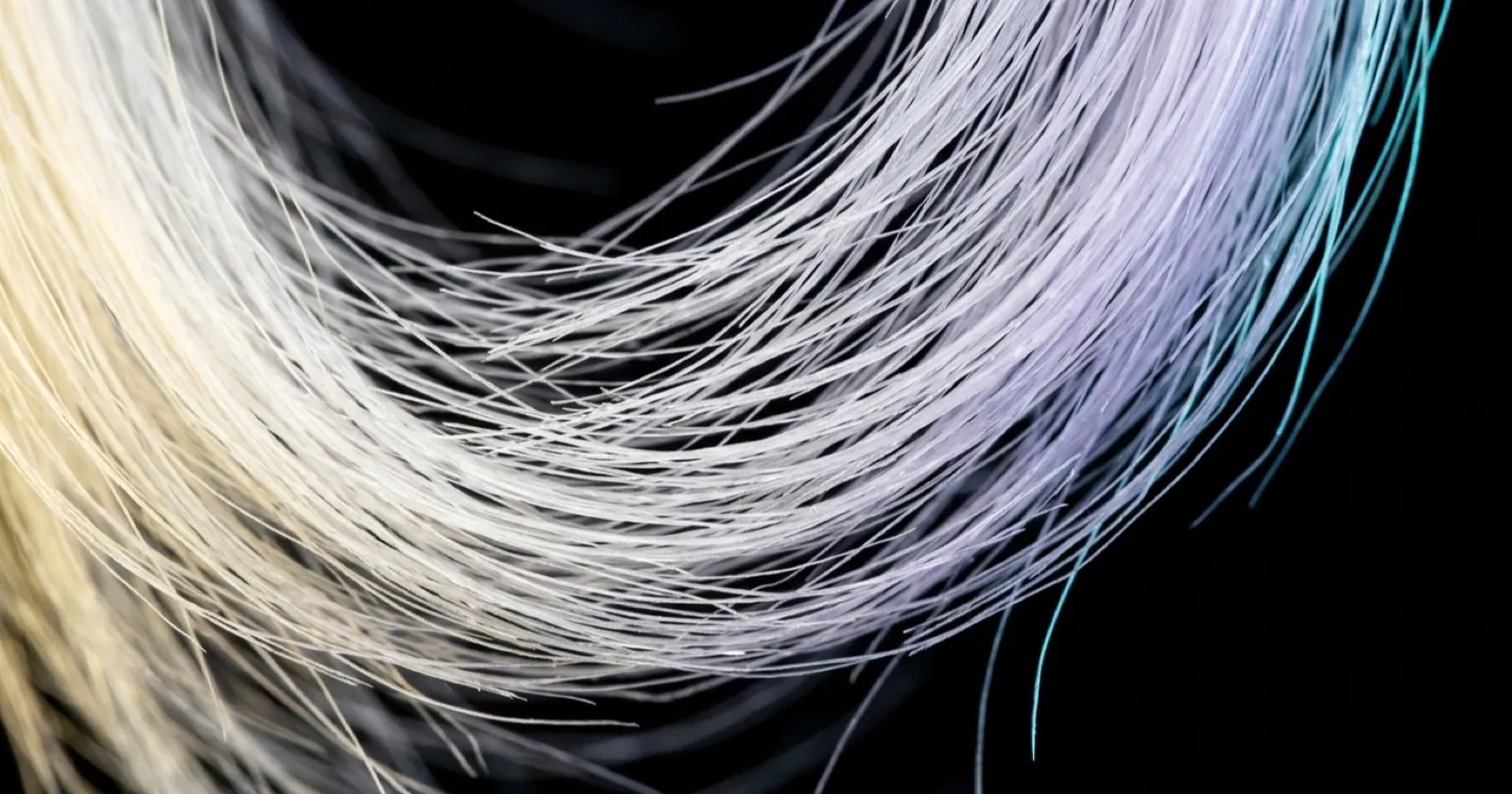
Gray and white hair can turn yellow because it has no melanin to hide the slow breakdown of its proteins. Research links the yellow to breakdown products of tryptophan, an amino acid in hair, and lab tests show that heat makes white hair yellower. Purple and blue shampoos change how the color looks. They add a faint violet or blue tint that cancels part of the yellow, so the hair looks cooler and more silver.
This page is part of our guide to caring for gray hair. It covers what the yellow is, what makes it worse, and how to use toning shampoo without overdoing it.
What the yellow is
Hair is built from proteins such as keratin, and proteins are built from amino acids. One of these amino acids, tryptophan, can break down into a family of compounds called kynurenines.
A 2009 study in the International Journal of Cosmetic Science measured gray hair from 11 people. The researchers separated the white hairs from the pigmented ones and measured each. The more yellow a white hair was, the stronger the signal from tryptophan breakdown products compared with tryptophan itself. Yellow white hair showed a build-up of one product in particular, 3-hydroxykynurenine. The study also found that tryptophan broke down along the length of each hair over time, faster in white hairs than in pigmented ones. The yellow grew stronger toward the ends, which are the oldest part of each hair.
Why is this easier to see in gray hair? A 2014 study in the Journal of Photochemistry and Photobiology B gives the plain reason: white hair has no melanin, so the effects of this kind of damage are more visible. The same study notes that the origin of yellowing is still not fully established. In that study, tests to identify the yellow compounds gave contradictory results.
Heat and light: what the lab tests found
Hair, and white hair in particular, is commonly said to turn yellower in the sun, as the authors of a 2007 study point out. Their lab results, and later ones, are less simple than that.
| What the hair was exposed to | Effect on white hair | Study |
|---|---|---|
| Full lamp light, and lamp light with UVB filtered out | Became less yellow | 2007, Journal of Photochemistry and Photobiology B |
| Infrared light | Became more yellow | 2007, Journal of Photochemistry and Photobiology B |
| Full-spectrum lamp for 200 hours | The yellower sample became less yellow; the less yellow sample became slightly yellower | 2014, Journal of Photochemistry and Photobiology B |
| Visible and infrared light | Bleached | 2014, Journal of Photochemistry and Photobiology B |
| Heat at 81 °C | Became more yellow | 2014, Journal of Photochemistry and Photobiology B |
Two points stand out. First, light can bleach white hair as well as yellow it. The result depends on the type of light and on how yellow the hair was to begin with. Second, when heat was tested directly, it made white hair yellower. A 2015 review in the International Journal of Trichology explains why: heat breaks tryptophan down into kynurenine-type compounds, and the result is yellowing of white hair.
Real hair spends months in daylight, and the 2009 study saw tryptophan break down along the hair as it aged. So sun may still play a part in daily life. But the clearest thing you can control is heat. The American Academy of Dermatology (AAD) suggests using the lowest heat setting on dryers and hot tools, limiting the time a hot tool touches your hair, and using these tools once a week or less. Our page on styling gray hair has more on styling with less heat.
Other things that can tint gray hair
- Tobacco smoke. A 2021 review in the journal Cureus describes yellow staining of white mustache hair in people who have smoked for years.
- Medicines and health problems. The same review lists environmental and work exposures, some medicines and certain nutrition problems, such as vitamin B12 deficiency, among known causes of yellow hair. If your hair changes color along with other changes in your health, see a doctor.
- Hard water. Is it to blame? A 2013 study in the International Journal of Trichology soaked hair samples in hard water every other day for 30 days. Their strength and stretch did not differ from samples soaked in distilled water. That study did not measure color, and we found no good study that links hard water to yellow hair.
How purple and blue toning works
Toning shampoos add a small amount of color to the hair. On a color wheel, purple sits opposite yellow, so a faint violet tint cancels part of a yellow cast, as a medically reviewed Healthline article explains. On white, gray or silver hair, the result is a cooler, more neutral look.
Blue-toned products rest on the same principle. In the physics of light, two colors that add up to white are called complementary, and yellow is the complement of blue, according to HyperPhysics at Georgia State University.
It helps to know what these products are not. Healthline describes purple shampoo as a toner, not a cleansing or moisturizing product. It is not a hair dye, and it does not lighten hair.
Using a toning shampoo well
- Read the label first. Products differ, so the directions on yours come first.
- Start slowly. Many purple shampoos are meant for once or twice a week rather than daily, according to Healthline. It says you should see a change after a few washes.
- Keep the contact time short. Healthline's instructions suggest leaving it on for 2 to 5 minutes unless the label says otherwise.
- Condition afterward. Healthline notes that some purple shampoos can dry the hair if used too often, and it recommends conditioner for moisture and detangling. The AAD also recommends conditioner after every shampoo.
- Watch for a tint. Overuse can give some hair a purple, pink or blue tint. If you see one, use the product less often.
What toning cannot do
A toning shampoo adds a violet or blue tint on top of the yellow. It hides the yellow cast, and the tryptophan breakdown products that cause it stay in the hair.
For very yellow ends, a trim is the most direct fix. The 2009 study found the yellow was strongest toward the ends, and those are the parts a trim removes. Cleveland Clinic also notes that regular trims keep hair from breaking.
It is easier to slow yellowing than to hide it. Keep heat low, protect your hair in strong sun (see gray hair and sun), and keep hair away from smoke. If your gray hair also feels drier than before, our page on why gray hair feels different explains what changes. For a shorter read on the causes, see why gray hair turns yellow, and for help choosing a shampoo, read does gray hair need a different shampoo.
LIUMIQ is a gradual color product for gray hair, and it is still in development. It cannot be bought yet. To follow the work, join the waitlist.
Questions
Research links the yellow to breakdown products of tryptophan, an amino acid in hair protein, and the yellow tends to build toward the older ends of the hair. In lab tests, heat made white hair yellower. Tobacco smoke can also stain white hair, and in rare cases medicines or nutrition problems play a part.
Follow the label, but many purple shampoos are meant for once or twice a week rather than daily, according to a medically reviewed Healthline article. Using it too often can leave a purple, pink or blue tint and can dry the hair. Use a conditioner afterward.
Both rely on the same color idea. Purple sits opposite yellow on the color wheel, and in the physics of light, yellow and blue are complementary colors. Healthline describes purple shampoo as the option for a yellow cast on white, gray or silver hair. Whichever you try, start with a short contact time and check the result.
The evidence is mixed. In lab tests, light that included ultraviolet sometimes made white hair less yellow, while direct heat made it yellower. Real hair is exposed to both for many months, and a 2009 study found yellow building up toward the older ends of white hairs.
Related reading
Sources
- 1.Fluorescence and coloration of grey hair, International Journal of Cosmetic Science
- 2.Yellowing and bleaching of grey hair caused by photo and thermal degradation, Journal of Photochemistry and Photobiology B: Biology
- 3.Photo yellowing of human hair, Journal of Photochemistry and Photobiology B: Biology
- 4.Hair cosmetics: an overview, International Journal of Trichology
- 5.Smoker's Mustache Revisited: Upper Lip Hair Yellow Discoloration Associated With Tobacco, Cureus
- 6.Effects of hard water on hair, International Journal of Trichology
- 7.Purple Shampoo: What Can it Do?, Healthline
- 8.Primary Colors, HyperPhysics, Georgia State University
- 9.10 hair care habits that can damage your hair, American Academy of Dermatology
- 10.How Fast Does Hair Grow? 10 Hair Growth Tips, Cleveland Clinic