Chapter 01 of 5
Why Gray Hair Feels Different From Your Old Hair
Many people say gray hair feels coarser and drier. Here is what fiber studies measured, what changes with age, and what it means for daily care.
Updated September 28, 2026
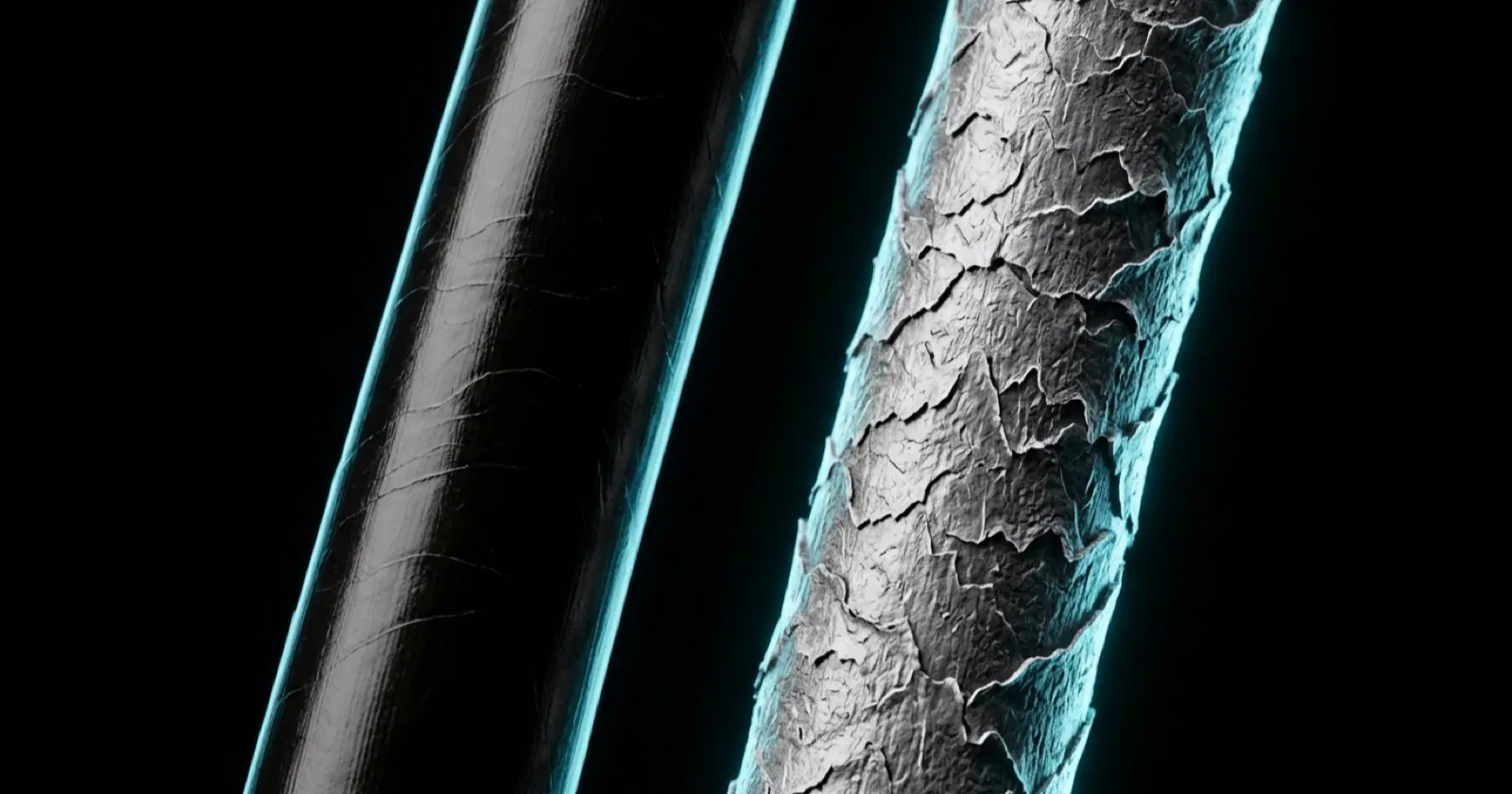
A common complaint is that gray hair feels coarser and drier than the hair it replaced. The research gives a mixed answer. Across groups of people, gray and pigmented hairs are more alike than different, but many individuals do have gray hairs that behave differently, and the age changes that arrive with graying affect all of the hair.
This page is part of our guide to caring for gray hair. It looks at what has been measured, what has not, and what the findings mean for daily care.
What people notice
The usual complaint is that gray hairs stick out from the rest and will not hold a style. A 2009 review in the International Journal of Trichology collects these reports. It says anecdotal evidence points to gray hair being coarser and less manageable, and that gray hair is said to often lose a set style and to resist artificial color. The same review is careful to add that it is not clearly established what causes this.
Part of the answer may simply be how visible gray hair is. A single white hair against darker hair is easy to see, so it can look wilder than it really is. The authors of a 2011 study in the International Journal of Cosmetic Science raised this exact point before they set out to test whether the difference is real.
What the measurements show
Three studies have compared gray or white hairs with pigmented hairs directly. They did not all agree.
| Study | Whose hair was tested | Main finding |
|---|---|---|
| Gao and Bedell, 2001, Journal of Cosmetic Science | Gray hair from individuals and commercial samples, compared with black hair | No significant difference in thickness, cross-section shape, strength or swelling |
| Van Neste, 2004, European Journal of Dermatology | 3,343 hairs from 24 women: 12 after menopause who had hair loss, and 12 younger women | White hairs were thicker, had a more developed central core and grew slightly faster |
| Kaplan and others, 2011, International Journal of Cosmetic Science | People with mixed gray and dark hair from a community that does not dye hair and limits sun | Few differences across the group, but many individuals had differences, mostly inside the fiber |
The 2011 study had the most careful design on one point. Its volunteers came from an Old Order Mennonite community. For cultural reasons, they do not chemically treat their hair, and they limit their time in the sun. So when a gray hair and a dark hair from the same person differed, dye and sun damage could not be the reason. Across the whole group, the researchers found few differences. Within many individuals, they did find differences, and these were larger inside the fiber than on its surface. The small differences in how the hairs responded to stretching and bending, and in how much water they took up and released, support the common complaint that gray hair is drier and harder to manage.
The 2004 study gives the clearest numbers. On average, white hairs measured 67.68 micrometers across, against 57.41 micrometers for pigmented hairs. White hairs grew 0.38 millimeters a day, against 0.35 for pigmented hairs. In this group, the slower growth that often comes with age showed up only in the pigmented hairs. Keep in mind that this was a small study of women, half of whom had hair loss, so the numbers may not fit everyone.
Why do the studies disagree? They tested different people, and the 2011 study suggests the answer really does vary from one person to the next. Your gray hair may feel very different from your old hair, or hardly different at all.
The medulla, the core of the hair
A hair shaft has three main parts: the cuticle on the outside, the cortex in the middle, and, in some hairs, a central core called the medulla. The 2015 review in the International Journal of Trichology notes that the medulla is present in coarser hair, such as gray hair, thick hair and beard hair.
The 2004 study scored how developed the medulla was, from 0 percent (absent) to 100 percent (fully developed). White hairs averaged 23.91 percent and pigmented hairs 12.21 percent. The 2009 review adds that the medulla is often enlarged in gray and white hairs.
Does a larger core make gray hair feel coarse? That has not been proven. The 2015 review does note that the medulla may be involved in hair splitting, because it gives cracks a weak path to travel along the fiber.
Age changes that come at the same time
Graying usually happens alongside other age changes, so it is hard to separate the two.
- Skin oil. A 1979 study in the Journal of Investigative Dermatology found that oil output from the skin's sebaceous glands falls gradually in women after menopause. In men it stayed essentially unchanged until age 80.
- The hair surface. A 2015 study of Japanese women aged 10 to 70 found that the cuticle becomes less resistant to daily brushing and washing with age. It also found that older hair lost more 18-MEA, a fatty layer on the hair surface, when weathered. The International Journal of Trichology review explains that this layer is what makes hair repel water. The changes appeared in the 40s and 50s.
- Shape and shine. A 2009 study of 230 Japanese women found that hairs become more irregularly curved with age. Because of this, hairs lie together less neatly and reflect less light, so hair looks less shiny.
Sun and weathering
Hair wears down slowly from sun, washing, drying and brushing. Researchers call this weathering. The 2009 review reports that gray hair has been found to be more sensitive to weathering and more reactive to chemical treatments. In a 2001 lab study, gray hair also suffered more severe UV damage than dark brown hair. Our page on gray hair and sun explains how to protect it.
What this means for daily care
You cannot change the fiber you grow. You can protect its surface and keep it from drying out.
- Condition every time. The American Academy of Dermatology (AAD) recommends conditioner after every shampoo. If your hair is dry or curly, it suggests putting conditioner on the whole length. A 2015 review for dermatologists in the Indian Journal of Dermatology explains that conditioners flatten the scales of the cuticle, reduce friction between hairs and improve shine.
- Handle wet hair gently. The AAD suggests a wide-tooth comb for wet hair and wrapping hair in a towel instead of rubbing it.
- Use less heat. The AAD suggests the lowest heat setting and using hot tools once a week or less. Heat can also turn white hair yellow, which our page on yellowing and purple shampoo explains.
- Choose a cut that suits the texture. Our page on styling gray hair covers cuts and products.
If you wonder whether your shampoo should change too, read does gray hair need a different shampoo. For the difference between gray and white hair, see white hair vs gray hair. And if you color your hair, why gray hair resists dye looks at the other side of the same question.
LIUMIQ is working on a gradual color product for gray hair. Nothing is for sale yet. You can join the waitlist to follow our progress.
Questions
Sometimes. A 2004 study of women's scalp hair found white hairs were thicker on average, 67.68 against 57.41 micrometers. A 2001 study found no significant difference in thickness between gray and black hair, so it varies between people and between studies.
Several things can add up. A 2011 study found small differences in how gray hairs take up and lose water, many women make less skin oil after menopause, and the hair surface becomes more fragile with age. Conditioner after every shampoo and less heat are the simplest steps.
In a 2004 study of women's scalp hair, white hairs grew 0.38 millimeters a day against 0.35 for pigmented hairs. The same study found that the slower growth that comes with age affected only the pigmented hairs. It was a small study, so treat the numbers as a guide, not a rule.
You can make it feel smoother. Conditioners flatten the scales of the cuticle and reduce friction between hairs, according to a 2015 review for dermatologists, and the American Academy of Dermatology recommends conditioner after every shampoo. Keeping heat low also limits damage to the hair surface.
Related reading
Sources
- 1.Grey hair: clinical investigation into changes in hair fibres with loss of pigmentation in a photoprotected population, International Journal of Cosmetic Science
- 2.Thickness, medullation and growth rate of female scalp hair are subject to significant variation according to pigmentation and scalp location during ageing, European Journal of Dermatology
- 3.Ultraviolet damage on natural gray hair and its photoprotection, Journal of Cosmetic Science
- 4.Oxidative stress in ageing of hair, International Journal of Trichology
- 5.Hair cosmetics: an overview, International Journal of Trichology
- 6.Age-related changes in sebaceous gland activity, Journal of Investigative Dermatology
- 7.Age-dependent changes in damage processes of hair cuticle, Journal of Cosmetic Dermatology
- 8.Changes in structure and geometric properties of human hair by aging, Journal of Cosmetic Science
- 9.Shampoo and Conditioners: What a Dermatologist Should Know?, Indian Journal of Dermatology
- 10.Tips for healthy hair, American Academy of Dermatology
- 11.10 hair care habits that can damage your hair, American Academy of Dermatology