Chapter 04 of 5
How the Sun Affects Gray Hair and How to Protect It
Why gray hair is more open to sun damage, what UV light does to hair proteins and color, and simple ways to protect gray hair outdoors and in pools.
Updated September 28, 2026
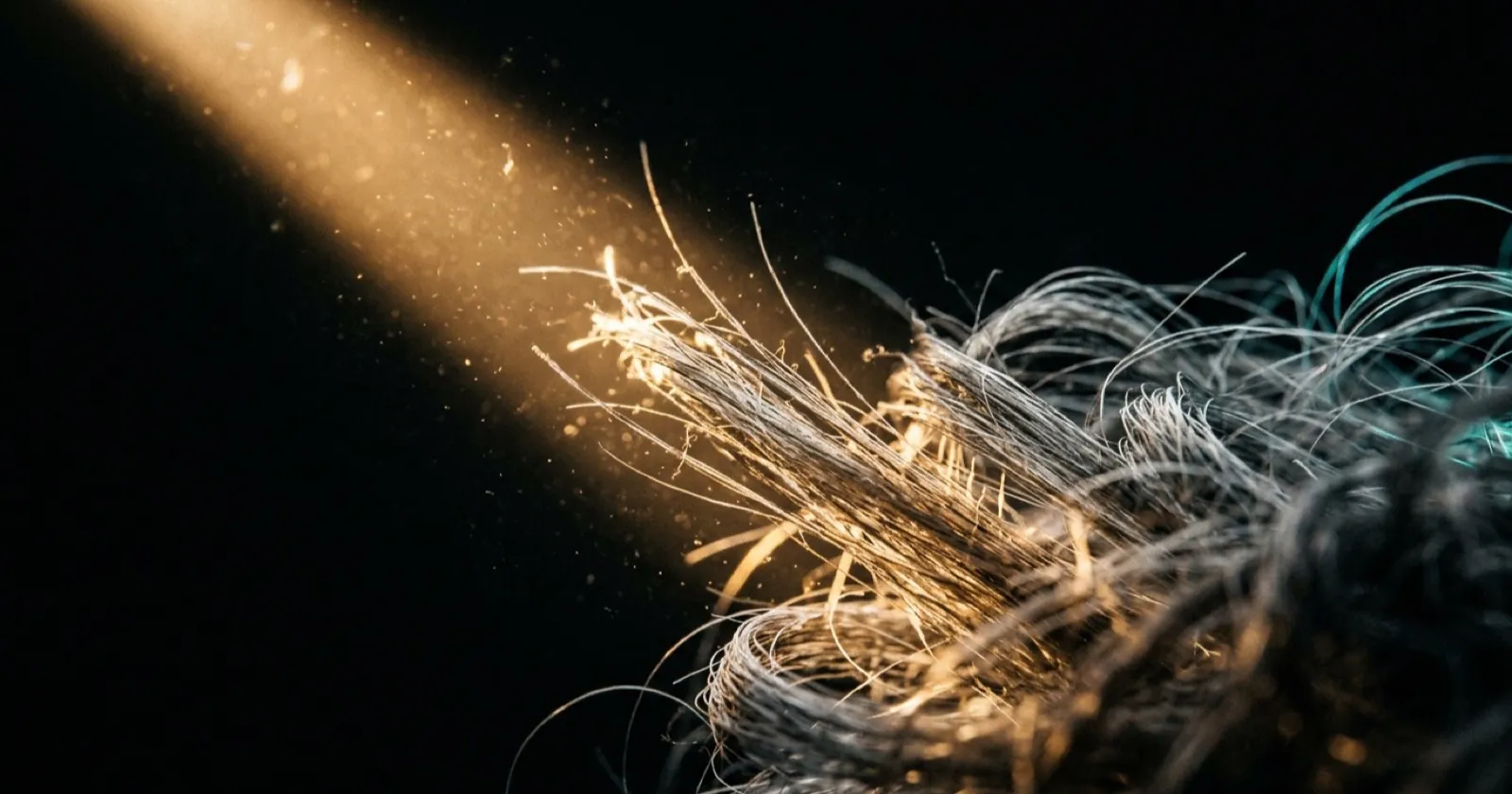
Sunlight damages all hair, but gray hair has less protection. Melanin, the pigment that gray hair lacks, absorbs part of the sun's radiation and releases it as heat, which shields the proteins in hair. A wide-brimmed hat, shade in the middle of the day, and some care around pools are the simplest ways to protect gray hair.
This page is part of our guide to caring for gray hair. It explains what the sun does to hair, why gray hair is more exposed, and which kinds of protection have evidence behind them.
What melanin does for hair
Melanin is more than color. A 2009 review in the International Journal of Trichology explains that hair pigments give photochemical protection to hair proteins. They do this by absorbing and filtering the incoming radiation and then releasing that energy as heat. The same review notes that the protective effect is related to the total amount of melanin in the hair.
Gray and white hairs have little or none. In an article for the American Academy of Dermatology (AAD), dermatologist Farah Moustafa says that lighter, blond or gray hair is more susceptible to sun damage than darker shades for exactly this reason. She explains that melanin protects against the free radicals that UV light creates and against their effects on keratin, a key protein in hair.
What UV light does to hair
Dr. Moustafa describes the result in plain terms. UV damage breaks down the proteins in hair and changes its color, and hair ends up dry and brittle, with less shine.
The lab research below points the same way:
- Protein loss. A 2004 study in the Journal of Photochemistry and Photobiology B exposed dark brown, blond, red and black hair to lamp light and to sunlight. Every hair type lost more protein afterward. The damage from UVB was about 2 to 5 times higher than from UVA plus visible light, depending on the hair type. Color changed in every type, and the change was larger in light hair. The study found no significant change in the hair's mechanical properties (how it stretches and breaks) or in its surface shape.
- Cuticle damage. The 2009 review reports that UVB damage stays mainly in the cuticle, the outer layers of the hair.
- Surface fats. A 2015 review in the International Journal of Trichology lists sunlight among the things that reduce the fatty layer on the hair surface. It also notes that sunlight, like bleach and dye, can weaken hair and increase friction between hairs, which leads to breakage.
Gray hair in the lab
The 2004 study did not include gray hair, but other research did. A 2001 study in the Journal of Cosmetic Science measured natural gray hair before and after UV exposure. It tested color, stiffness, strength, combing force, damage to the amino acid tryptophan, and wear on the cuticle. The authors concluded that gray hair suffers more severe UV damage than dark brown hair and needs more UV protection.
Another 2009 review in the International Journal of Trichology adds that gray hair has been found to be more sensitive to weathering, the slow wear that sun, washing and brushing cause over time.
Does the sun turn gray hair yellow?
The answer is less clear than the common claim. The authors of a 2007 lab study note that hair, and white hair in particular, is commonly said to turn yellower in the sun. They found that lamp light including ultraviolet made white hair less yellow, and that only infrared light made it more yellow. A 2014 study found that light could either yellow or bleach white hair, depending on the type of light and how yellow the hair was to start with. Direct heat made it yellower.
Real hair spends months outdoors, though. A 2009 study found tryptophan breaking down along white hairs as they aged, with yellow building toward the ends. Our page on yellowing and purple shampoo covers the causes and what toning can do, and our post on why gray hair turns yellow gives a shorter summary.
How to protect gray hair from the sun
| Method | What it does | Notes |
|---|---|---|
| Wide-brimmed hat | Shades the hair and scalp | The AAD's first suggestion |
| Timing | Avoids the strongest sun | The AAD suggests avoiding peak hours, typically 10 a.m. to 2 p.m. |
| Shade | Cuts direct exposure | Also recommended by the AAD |
| Leave-in conditioner, spray or powder with SPF | Adds a UV filter to the hair | The AAD notes these exist; no regulated test measures how well they work |
| Leave-in conditioner with zinc oxide | Adds a UV filter | The AAD suggests it for colored hair in the sun |
| Sunscreen on the scalp | Protects the scalp where hair is thin | The AAD suggests scalp sunscreen or a hat if your hair is thinning |
A hat is the most predictable of these. The reason is a gap in testing. A 2015 review in the Journal of Photochemistry and Photobiology B points out that hair products have no regulated way to measure sun protection, unlike sunscreen for skin. That makes published results impossible to compare. The same review notes that hair sun protection products usually rely on silicones, antioxidants and UV filters with a positive charge, which cling better to the negatively charged hair surface.
The 2001 study tested this idea on gray hair. A UV filter with a positive charge, delivered from a simple shampoo, stayed on the hair better and protected it better than a standard UV filter. That was a lab result on hair samples, not a test of any product you can buy. If you want to know whether your shampoo should change, our post on does gray hair need a different shampoo goes through it.
Pools and the beach
Chlorine adds to sun damage. Dr. Moustafa explains that chlorine dissolves the hair's lipids, the natural fats that coat the hair shaft and protect it, which leaves hair more open to damage and split ends. Chlorine can also break chemical bonds in hair protein.
The AAD's advice for swimmers:
- Wear a swim cap.
- If a cap is not comfortable, put oil or a leave-in conditioner on your hair before you get in the pool. This makes a barrier between your hair and the chlorine.
- Rinse your hair right after swimming.
- Wash with a swimmers' shampoo, then use a deep conditioner.
The AAD article also notes that chlorine can work with copper in pool water to give blond hair a green tint. Its advice is written for pools. We did not find dermatology guidance on sea water specifically.
After a day in the sun
After sun or a swim, focus on moisture and gentle handling. The AAD recommends conditioner after every shampoo. Use less heat afterward, too: heat can turn white hair yellow, and the AAD suggests the lowest setting on hot tools. Our page on styling gray hair explains how to style with less heat. If your gray hair feels drier than your old hair even without sun, why gray hair feels different explains what the research says.
LIUMIQ is developing a gradual color product for gray hair, and it is not on sale yet. If you would like updates, join the waitlist.
Questions
The evidence we found says yes. A dermatologist writing for the American Academy of Dermatology says gray hair is more susceptible than darker shades because it lacks melanin. A 2001 lab study also found that gray hair suffered more severe UV damage than dark brown hair.
A wide-brimmed hat is the simplest option, and the AAD also suggests avoiding peak sun from 10 a.m. to 2 p.m. Leave-in conditioners and sprays with sun protection exist, but hair products have no regulated sun protection test. That makes their results hard to compare.
If your hair is thinning, the AAD says to either apply sunscreen to your scalp or wear a wide-brimmed hat. A hat has the advantage of shading your hair and scalp at the same time.
The AAD suggests a swim cap, or oil or leave-in conditioner on your hair before you get in the pool. Rinse right after swimming, then wash with a swimmers' shampoo and follow with a deep conditioner. Chlorine dissolves the natural fats that coat and protect the hair.
Related reading
Sources
- 1.Photoaggravation of hair aging, International Journal of Trichology
- 2.Must-try summer hair care, American Academy of Dermatology
- 3.Hair color changes and protein damage caused by ultraviolet radiation, Journal of Photochemistry and Photobiology B: Biology
- 4.Ultraviolet damage on natural gray hair and its photoprotection, Journal of Cosmetic Science
- 5.Oxidative stress in ageing of hair, International Journal of Trichology
- 6.Hair cosmetics: an overview, International Journal of Trichology
- 7.Photo yellowing of human hair, Journal of Photochemistry and Photobiology B: Biology
- 8.Yellowing and bleaching of grey hair caused by photo and thermal degradation, Journal of Photochemistry and Photobiology B: Biology
- 9.Fluorescence and coloration of grey hair, International Journal of Cosmetic Science
- 10.Effects of solar radiation on hair and photoprotection, Journal of Photochemistry and Photobiology B: Biology
- 11.10 hair care habits that can damage your hair, American Academy of Dermatology
- 12.How to apply sunscreen, American Academy of Dermatology